 sciBASIC#
↖
sciBASIC#
↖
06 Tutorial — Word embeddings
Train CBOW word vectors on the tale of Rapunzel, then unfold the embedding with UMAP and k-means.
One fairy tale, one model, one picture of a vocabulary. The Grimm text of Rapunzel is segmented into sentences and fed to a continuous bag-of-words trainer (30 dimensions, min term frequency 1, single thread). The resulting 461 word vectors are projected onto a 9-dimensional UMAP manifold, partitioned into nine k-means clusters, and drawn as a Nature-themed scatter of UMAP1 vs UMAP2 — with the full coordinates exported to CSV.
02 Pipeline
From fairy tale to 9-D embedding
Segment
Paragraph.Segmentation splits the Rapunzel text into paragraphs of sentences, and every
sentence stream is handed to wv.readTokens.
Train
BuildWord2VecFactory configures a continuous bag-of-words model —
setVectorSize(30), TrainMethod.CBow, setFreqThresold(1), a single
thread — and wv.training() runs the pass over the tokens.
Embed
The 461 word vectors are pushed through umap(dimensions:=9, numberOfNeighbors:=64):
InitializeFit + Step(n_epochs) produce the 9-D manifold.
Cluster
Kmeans(k:=9) partitions the embedding; ClassId recovers cluster colors and
the first two UMAP dimensions become the plot coordinates.
Export
A Nature-themed scatter saves the 300-dpi PNG, and the full 461 × 11 table is written to CSV
with WriteCsv.
01 The Script
Full demo source
The complete script exactly as executed by the sciBASIC# script engine (vbs.exe) — nothing elided.
#include "Microsoft.VisualBasic.Data.NLP.Word2Vec.dll"
#include "Microsoft.VisualBasic.Data.NLP.dll"
#include "Microsoft.VisualBasic.DataMining.Framework.dll"
#include "Microsoft.VisualBasic.Drawing.dll"
#include "Microsoft.VisualBasic.Data.DataPlot.dll"
#include "Microsoft.VisualBasic.Data.Framework.dll"
#include "Microsoft.VisualBasic.Math.Randomizer.dll"
#include "Microsoft.VisualBasic.DataMining.UMAP.dll"

Imports Microsoft.VisualBasic.Data.NLP.Word2Vec
Imports Microsoft.VisualBasic.Data.NLP.Model
Imports Microsoft.VisualBasic.Data
Imports Microsoft.VisualBasic.Data.Framework
Imports Microsoft.VisualBasic.DataMining
Imports Microsoft.VisualBasic.DataMining.Kmeans
Imports Microsoft.VisualBasic.DataMining.UMAP
imports microsoft.visualbasic.data.plots
imports microsoft.visualbasic.drawing

' ---------------------------------------------------------------------------
' Word2Vec + UMAP + KMeans demo
'
'   Rapunzel text -> Word2Vec training -> word vector table
'    -> UMAP embedding -> KMeans clustering -> scatter plot -> export csv
' ---------------------------------------------------------------------------
dim textfile = here("../../data/Rapunzel.txt")
dim wv As Word2Vec = BuildWord2VecFactory() _
    .setVectorSize(30) _
    .setMethod(TrainMethod.CBow) _
    .setNumOfThread(1) _
    .setFreqThresold(1) _
    .build()
Dim data As Paragraph() = Paragraph.Segmentation(textFile.ReadAllText).ToArray

For Each p As Paragraph In data
    For Each line In p.sentences
        Call wv.readTokens(line)
    Next
Next

call wv.training()

' ---------------------------------------------------------------------------
' 1. Build the trained word vector collection into a unified 2D table object
'    (NumericTable)
'
'    + row names  = the word token
'    + features   = v_1 .. v_n, i.e. the word vector of each token
'
'    All the following operations (dimension reduction, clustering, export) are
'    performed directly on this table
' ---------------------------------------------------------------------------
dim vector = wv.outputVector()
dim tokens = vector.tokens
dim colnames = fieldname("v", n := vector.vectorSize).toarray()
dim rows As Double()() = New Double(tokens.length - 1)() {}

for i = 0 to tokens.length - 1
    dim raw = vector.wordMap(tokens(i))
    dim vals(raw.length - 1) as double

    for j = 0 to raw.length - 1
        vals(j) = CDbl(raw(j))
    next

    rows(i) = vals
next

dim table = NumericTable.FromRows(tokens, rows, colnames)

call console.WriteLine($"word vectors: {table.nsamples} tokens x {table.nfeatures} dims")

' ---------------------------------------------------------------------------
' 2. Use UMAP to reduce the word vectors to 9 dimensions
'
'    The umap method accepts the unified 2D table and returns a new table whose
'    features are the embedding coordinates dim_1..dim_n; the row names and the
'    existing label columns are inherited
' ---------------------------------------------------------------------------
dim manifold = table.umap(dims := 9, neighbors := 64)

call console.WriteLine($"umap embedding: {manifold.nsamples} samples x {manifold.nfeatures} dims")

' ---------------------------------------------------------------------------
' 3. Run KMeans clustering on the reduced table
'
'    The clustering result is written into the label matrix of the table as the
'    label column cluster
' ---------------------------------------------------------------------------
dim clusters = manifold.kmeans(k := 9)

' ---------------------------------------------------------------------------
' 4. Extract the data needed for plotting from the result table
' ---------------------------------------------------------------------------
dim x = manifold.Feature("dim_1")
dim y = manifold.Feature("dim_2")
dim class_id = clusters.ClusterLabels()
dim classes(class_id.length - 1) as string
dim sizes(8) as integer

for i = 0 to class_id.length - 1
    classes(i) = class_id(i).ToString()
    sizes(class_id(i) - 1) += 1
next

call console.WriteLine($"kmeans cluster sizes: {String.Join(", ", sizes)}")

call SkiaDriver.Register()

Using plt As New ScatterPlot(800, 600, PlotTheme.Nature())
    plt.Title = "UMAP group of Rapunzel"
    plt.SubTitle = "UMAP scatter of the 'Rapunzel' word2vector embedding result"
    plt.XLabel = "UMAP1"
    plt.YLabel = "UMAP2"
    plt.Plot(DataSerials(x, y, classes).tolist())
    plt.SavePng(here("rapunzel-umap-groups.png"), 300)
End Using

' ---------------------------------------------------------------------------
' 5. Export the clustering result table as csv
'
'    The exported layout also follows the convention of
'    "row names + feature columns + label: prefixed label columns", so it can
'    be loaded back losslessly through NumericTableIO.ReadCsv
' ---------------------------------------------------------------------------
call clusters.WriteCsv(here("rapunzel-umap-groups.csv"))

call console.WriteLine("done: rapunzel-umap-groups.png")
call console.WriteLine("done: rapunzel-umap-groups.csv")
04 Results
The word-vector manifold
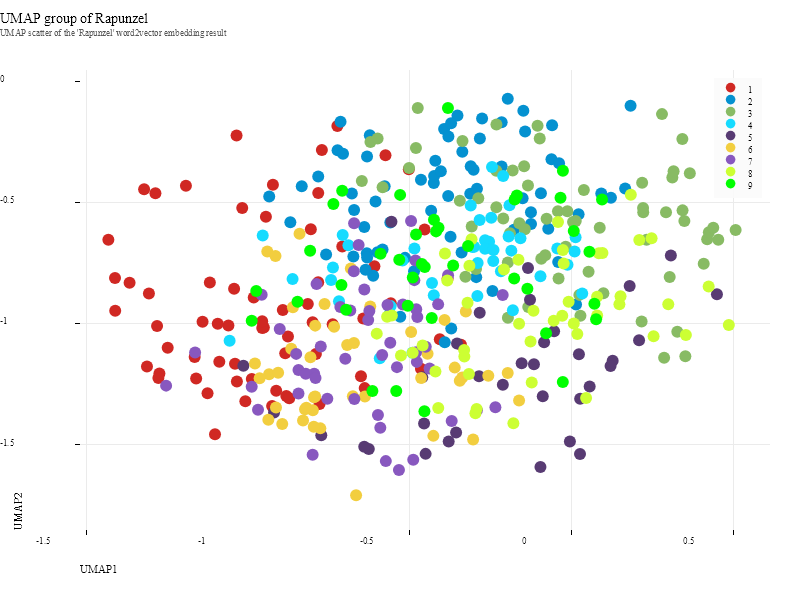
and, had, long,
to…) holds the left side, content-word neighborhoods weave through the middle, and
recurring word families settle along the lower arc.05 Table preview
rapunzel-umap-groups.csv
461 vocabulary words × 9 UMAP dimensions + cluster label. The first and last rows of the exported table:
| word | dim_1 | dim_2 | dim_3 | dim_4 | dim_5 | dim_6 | dim_7 | dim_8 | dim_9 | label:cluster |
|---|---|---|---|---|---|---|---|---|---|---|
| There | 3.56365143724127 | -2.0734000598497624 | -1.6198605900202898 | -0.14376740383342634 | -2.4854460625022785 | -1.006297590081116 | -3.6068850016078593 | -1.6569097646708442 | -1.4351187048684615 | 4 |
| were | 3.0914420761104258 | -1.958015080620244 | -2.0611864797111643 | 1.0601210819504878 | -2.421050814004005 | -0.5451589911057511 | -2.5416505018427222 | -2.127647654171174 | -0.7181974980585668 | 3 |
| once | 3.289039017936846 | -1.4619525008248608 | -1.6566385945397333 | 0.11159778851742302 | -2.247780361752952 | -1.594633756897961 | -2.9916830355064667 | -1.2217044701082365 | -0.5546190697699069 | 1 |
| a | 2.887581462689212 | -2.071979678993014 | -1.3020498293035119 | 0.543122471492502 | -2.120513215470194 | -1.2916062091648675 | -3.0632017744169233 | -0.7273641103968851 | -1.1937563198498398 | 9 |
| ··· | ||||||||||
| afterwards | 2.7490901765149736 | -2.0951038677069533 | -1.7638045724187805 | 0.05883449852269965 | -1.802902414524226 | -1.204151837311557 | -2.3851538916094195 | -1.94099085443912 | -0.5667952836038509 | 6 |
| happy | 2.3074653272538312 | -1.665422861944701 | -0.9934313617713261 | 0.49274067258745763 | -2.265759595867058 | -1.614801199608761 | -2.7155739136551 | -1.7584221848531272 | -1.621409068163697 | 6 |
| contented | 3.178361223400942 | -1.81659696214847 | -2.1061329581439043 | -0.33406266420931685 | -2.3633787915082607 | -0.5747379469595877 | -2.7257357726893594 | -1.0757773302040399 | -1.1568894693593994 | 4 |
Cluster sizes
| Cluster | Words | First members |
|---|---|---|
| Cluster 4 | 67 | There, man, wished, child, hoped, was’… |
| Cluster 3 | 55 | were, desire, garden, no, dreaded, this’… |
| Cluster 1 | 52 | once, and, woman, who, little, their’… |
| Cluster 9 | 60 | a, length, of, from, beautiful, flowers’… |
| Cluster 7 | 55 | had, vain, the, that, about, her’… |
| Cluster 8 | 36 | long, in, God, be, surrounded, high’… |
| Cluster 2 | 34 | for, to, These, one, an, enchantress’… |
| Cluster 6 | 60 | At, window, back, house, splendid, by’… |
| Cluster 5 | 42 | bed, Ah, his, salad, ate, him’… |